Philosophical study of life, death, and nature
Philosophical study of life, death, and nature
|
   |
|
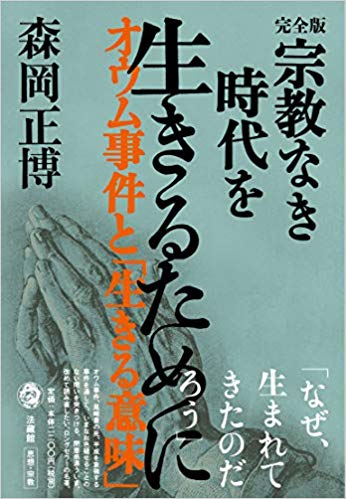
>> PDF (Open access book) This is a book that proposed a third way between religion and science. It was written in response to the Aum Shinrikyo cult's 1995 sarin nerve gas attack on Tokyo's subway systems, an attack made in the name of their pursuit of "truth" and "awakening." Foreword to the English Edition Preface Chapter 1 Between Science and Religion 1. An Uncomfortable Feeling about Faith Chapter 2 What Are Mystical Experiences? 1. The Meaning of Mystical Experiences Chapter 3 The Trap of Healing and Salvation 1. Aum and Yutaka Ozaki Chapter 4 The Courage to Be Myself 1. Ineffective Prescriptions Postscript
In 1995, members of a Japanese cult, called "Aum Shinrikyo" launched a sarin nerve gas attack in crowded subways in Tokyo. 12 people were killed and more than 5,000 people were injured. In the beginning, Aum Shinrikyo was a small religious group earnestly seeking the "meaning of life." They began to consider our society to be dirty, and planned to destroy it in order to construct one that was cleaner or more pure. After this tragic event, the mass media began to criticize the madness and cruelty of Aum Shinrikyo. However, several writers, including me, realized that this should be interpreted as a kind of pathology of the modern age, and that all of us shared this pathology with the members of Aum Shinrikyo. Actually, they and I shared the same aspiration, that is, a desire to ascertain the real meaning of life. They believed in religion, and used advanced scientific technology as a tool for acquiring enlightenment. But I did not become a scientist, nor did I believe in religion. Instead, I proposed a new research field, "life studies," in which the meaning of life, death, and nature is pursued without using religious language. This book was published in 1996, a year after the Sarin gas incident. It has come to be regarded as one of the most important books on the Aum Shinrikyo attack. It has also been supported by many young readers who are interested in spirituality and the question of the meaning of life. My first major at university was physics, just like many of Aum's young researchers. When I chose this major, I thought that the mysteries of the universe and of human beings would be solved by physics and mathmatics. Then I realized that this idea was completely wrong. I was disappointed by science, and changed my major to philosophy. I became interested in religious approaches, but I finally found that I could not believe in religion. In Chapter 1 of this book, I describ my internal journey from physics to religion, and I explain why I decided to follow a third way between science and religion. In Chapters 2 and 3, I point out some of the traps a closed religious community can fall into looking at the examples of Aum and the well-known Japanese singer, Yutaka Ozaki. In Chapter 4, I propose a new way of grasping spirituality and the meaning of life without using religious language.
Book Reviews Shin'ichi Nakazawa, Chuo University - "This book contains a great possibility. ..." (Yomiuri Shimbun, 1996) Ryuichiro Matsubara, University of Tokyo - "An example can be found in a recent book by Morioka Masahiro that tries to come to terms with Aum Shinrikyo (Supreme Truth) and the crimes this doomsday cult has committed. As a person who has shared the kind of experience Aum's young followers are going through, Morioka has no patience for the so-called religious experts who have been roundly thrashing this sect from the sidelines. To the charge that Aum is a devil bent on destroying civil society, he responds that when civil society is so obsessed with competition that nobody has time for pondering questions of life and death, it is bound to develop cracks through which groups like Aum step forth. (.....) Whether one subscribes to a religion or is an agnostic or atheist, Morioka holds, philosophy is necessary for life. It is acquired by "thinking through with your own head and in your own words what meaning you, as an individual who will only live and die once, will attribute to the world and to your life over the course of your existence."" (Japan Echo, 1996, 23:2) >> Read more Book reviews also appeared in Asahi, Mainichi, Sankei newspapers, Kyodo Tsushin, and other publications. Publication Data Hozokan, Tokyo, Mar.10, 1996, 229 pages, 1942 yen, written in Japanese. Japanese website for this book
|