
Philosophical study of life, death, and nature
Philosophical study of life, death, and nature
|
   |
|
This book describes a new way of thinking about bioethical issues: a life studies approach. Original concepts such as "the fundamental sense of security","the reality of a deeply shaken self", "men's bioethics," and "the advent of an absent being" are introduced and discussed. In this book I discussed issues surrounding brain death, reproductive technologies, Japanese feminist approaches to bioethics, and Japanese debates on disability and bioethics from the viewpoint of "life studies," a new perspective which I have been promoting for many years. Readers will find a new way of looking at these bioethical problems. Most materials cited in this book were published in the 1970s, but the discussions they contain are still current and very stimulating. I have learned a lot from the discussions and experiences of those writings in this period. I believe thier works are a rich source of inspiration for future work in bioethics and "life studies." In Chapter 2, I criticize the "personhood" argument in bioethics, and instead presented a different concept, "the reality of a deeply shaken self," which Mitsu Tanaka, a Japanese feminist, used in her writings as a basic concept of the women's liberation movement at that time. In Chapter 6, after discussing selective abortion and a new eugenics, I propose an idea, "the fundamental sense of security," which I assert ought to become a basic concept for thinking about our society in the age of biotechnology. In Chapter 1 I discuss the idea of "the advent of an absent being" that appears on the body of a brain dead person surrounded by close family members. I also discuss men's sexuality and abortion, which has been one of the least discussed topics in the field of bioethics. I propose "men's bioethics" as an important field of research that lies between bioethics and men's studies. The combination of "feminist approaches", "disability studies", and "life studies" will surely have a profound influence on future bioethics. You can read a brief summary of some of the chapters of this book in the following papers, "Painless Civilization and Fundamental Sense of Security" (about "fundamental sense of security"), "What do we Learn from Japanese Feminist Bioethics?" (about "the reality of a deeply shaken self," or "the turmoil of the shaken self") and "Reconsidering Brain Death: A Lesson from Japan's Fifteen Years of Experience." For more information about life studies see What is Life Studies page. When translation is completed, this book will probably be the first full-scale introduction of Japanese feminist bioethics and disabled people's bioethics in the 1970s to the English-speaking world. Since the publication of this book, research on Japanese feminist bioethics and disabled people's bioethics has greatly progressed. For example, in 2009 Masae Kato published Women's Rights? The Politics of Eugenic Abortion in Modern Japan, which contains an abundant material on Japanese feminist voices on abortion in the 1970s in English. I am planning to expand the perspective of this book and rewrite it in the coming years. Preface Chapter 1
Chapter 2
Chapter 3
Chapter 4
Chapter 5
Chapter 6
Chapter 7
Book Reviews Osamu Kanamori, University of Tokyo - "This is an important book. Various topics such as brain death, abortion, eugenic thought, and feminism are discussed as part of a discourse on life, but there is a firm backbone forming a solid foundation for the text as a whole." (Yomiuri Shimbun Newspaper, Jan.20,2002) Mariko Hasegawa, The Graduate University for Advanced Studies - "This is a book on bioethics, but the author does not seek to carry out a detailed analysis of current bioethics. Instead, after discussing these subjects, the author proposes a completely new research field, "life studies."" (Nikkei Shimbun Newspaper, Jan.6,2002) Natsuko Yoshizawa, Rikkyo University - "I was astonished by the fact that bioethics is based on a poor view of humanity that regards only humans with consciousness and rationality as persons, and also astonished by the fact that Japanese women's liberation activists and disabled people have created such a rich and fruitful discourse on abortion since the 1970s." (Asahi Shimbun Newspaper, Jan.13,2002) Book reviews also appeared in Kyoto, Dokushojin, and Tosho newspapers, Ronza magazine, and other publications. Publication Data Keiso Shobo, Tokyo, Nov.10, 2001, 494 pages, 3800 yen, written in Japanese. Japanese website for this book 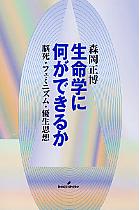
|


